
When people talk about improving gut health, the conversation usually goes straight to food. What to eat. What to avoid. Which probiotic to take.
That is the right place to start. But there is a category of intervention that gets far less attention despite having solid research behind it and that is what you do with your mind and your breath.
The gut-brain connection is a physical, biological reality. And practices that calm the nervous system (particularly meditation and breathwork) produce real, measurable changes in gut function, not just in how stressed you feel.
This post explains the mechanism behind that, what the research shows, and how to actually use these practices in a way that is accessible even if you have never meditated before.
Why the Nervous System Is Central to Gut Health
To understand how meditation helps the gut, you first need to understand how the nervous system controls it.
Your gut has its own nervous system (the enteric nervous system) containing about 500 million nerve cells. But it is also in constant communication with the central nervous system through the vagus nerve and the broader autonomic nervous system.
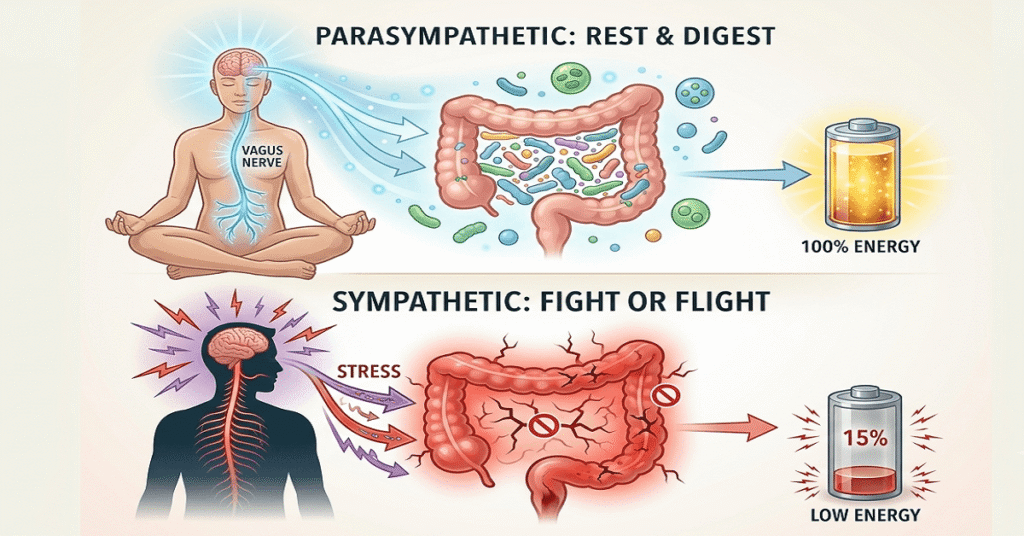
The autonomic nervous system has two modes:
Sympathetic mode – “fight or flight”: This is your stress response. When it activates, blood flow is redirected away from the gut toward the muscles and vital organs. Gut motility slows. Digestive enzyme production decreases. The gut lining becomes more permeable. Inflammation increases.
Parasympathetic mode – “rest and digest”: This is the recovery and digestion mode. Blood flow returns to the gut. Digestive enzyme production resumes. Gut motility normalizes. The gut lining repairs and tightens. Inflammation reduces.
The problem for most people is that chronic stress keeps the body partially locked in sympathetic mode most of the time. The gut is trying to digest food and maintain its lining while the nervous system is signaling that it should be doing something else.
Meditation and breathwork are the most accessible and direct tools available for shifting the nervous system from sympathetic to parasympathetic mode and doing it consistently enough to change the gut’s baseline function over time.
The Vagus Nerve - The Bridge Between Practice and Gut
The vagus nerve is the primary highway between the brain and the gut. It is the main nerve of the parasympathetic system carrying “rest and digest” signals downward from the brain to the heart, lungs, and digestive system.
Here is what is particularly interesting: stimulating the vagus nerve directly activates the parasympathetic response in the gut. And several common practices stimulate it measurably including slow diaphragmatic breathing, humming, cold water on the face, and mindfulness meditation.
Vagal tone is a measure of how responsive and active the vagus nerve is. People with high vagal tone recover from stress faster, have lower baseline inflammation, and (relevant to this post) have better gut motility, less gut permeability, and more resilient gut microbiomes.
Consistent breathwork and meditation increase vagal tone over time. This is not metaphorical. It is measurable with heart rate variability (HRV) – a validated physiological marker of vagal activity.
Research published in Frontiers in Psychiatry has documented that mindfulness-based interventions significantly increase heart rate variability directly reflecting improved vagal tone.
Research reference: Frontiers in Psychiatry – mindfulness and heart rate variability: https://www.frontiersin.org/articles/10.3389/fpsyt.2018.00315/full
Breathwork: The Most Direct Gut Health Tool
Of all mind-body practices, breathwork is the most directly connected to gut function because it physically stimulates the vagus nerve with every breath.
Here are the three most research-supported breathing practices for gut health specifically:
1. Slow Diaphragmatic Breathing (4-7-8 or Box Breathing)
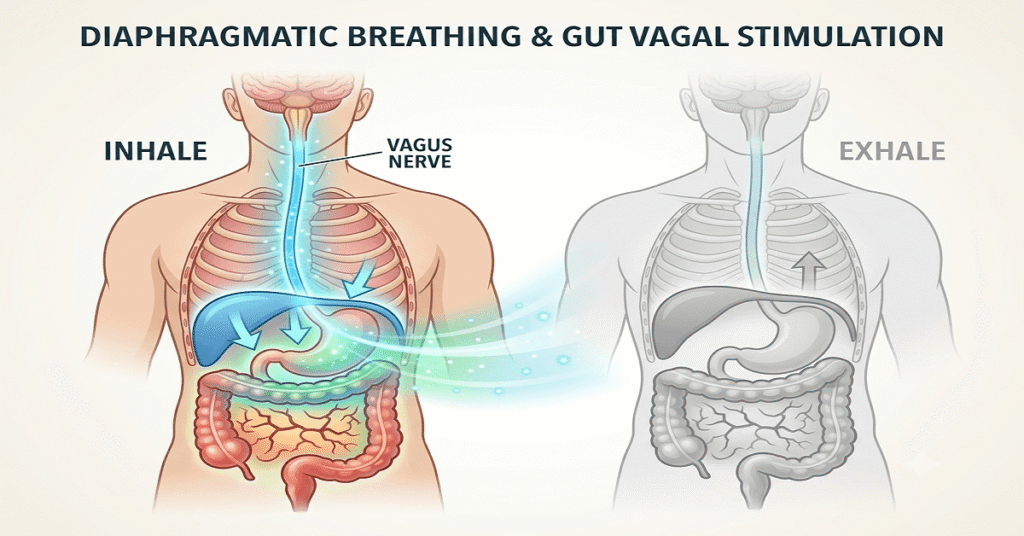
What it is: Breathing slowly and deeply into the belly expanding the diaphragm rather than the chest while extending the exhale longer than the inhale.
The extended exhale is the key mechanism. A longer exhale directly activates parasympathetic activity and reduces sympathetic tone. When the exhale is longer than the inhale, heart rate slows, vagal activity increases, and the gut receives parasympathetic signals.
How to do it:
- Inhale slowly through the nose for 4 counts, feeling the belly expand (not the chest)
- Hold for 2 counts
- Exhale slowly through the mouth or nose for 6 to 8 counts – push the air all the way out
- Repeat for 5 to 10 minutes
When to use it: Before meals to prepare the gut for digestion, during any moment of digestive discomfort, or as a daily morning practice. Even 5 minutes produces a measurable shift in autonomic state.
2. Resonance Breathing (Coherent Breathing)
What it is:
Breathing at a rate of approximately 5 to 6 breaths per minute (slower than normal breathing) which has been shown to maximize heart rate variability and vagal tone.
At this breathing rate, the respiratory rhythm naturally synchronizes with cardiovascular rhythms in a way that maximizes parasympathetic activity. This is sometimes called coherent breathing
.
How to do it:
- Inhale for 5 seconds
- Exhale for 5 seconds
- Repeat continuously for 10 to 20 minutes
- Use a pacing app or audio to keep rhythm (many free options are available)
Research reference: Applied Psychophysiology and Biofeedback – coherent breathing and heart rate variability: https://pubmed.ncbi.nlm.nih.gov/16700648/
This is the practice I use most consistently. I started with 10 minutes each morning using a simple phone app for pacing. Within about three weeks, I noticed my digestion felt more predictable particularly the post-meal bloating that had been a constant companion. I cannot say with certainty that the breathwork was the only change, but it was the most significant thing I had added at that point.
3. Humming Breath (Bhramari Pranayama)
What it is: Inhaling normally and then humming audibly on the exhale. Humming stimulates the vagus nerve directly through vibration in the throat and chest cavity, and also activates the release of nitric oxide in the nasal passages which has anti-inflammatory effects.
How to do it:
- Inhale slowly and deeply
- On the exhale, hum a single steady note, feel the vibration in your throat and chest
- Continue for 5 to 10 breath cycles
This is the least well-known of the three practices but has some of the most direct vagal stimulation research behind it. The humming does not need to be loud -> a gentle, sustained hum on each exhale is enough.
Meditation for Gut Health - What Actually Works
Not all meditation is equally useful for gut health specifically. Here is what the research supports:
Mindfulness-Based Stress Reduction (MBSR)
The MBSR program developed by Jon Kabat-Zinn at the University of Massachusetts is the most thoroughly researched meditation intervention in medical literature. It involves 8 weeks of structured mindfulness practice including both formal meditation and body scan exercises.
MBSR has the strongest research base for IBS, chronic pain, and inflammatory conditions all of which involve gut components. Multiple randomized trials show meaningful reductions in gut symptom severity in IBS patients following MBSR programs.
You do not need to attend an 8-week program. The core practices (body scan meditation, mindful breathing, and mindful eating) are available through apps and free online resources.
Body Scan Meditation
The body scan involves lying down and progressively moving attention through the body from feet to head, noticing physical sensations without judging them. It is particularly relevant for gut health because it builds interoceptive awareness the ability to notice what is happening inside your body.
For people with IBS or gut dysbiosis, improving interoceptive awareness helps identify and respond to gut signals including early signals of discomfort that, when noticed early, can be managed more effectively.
Practical starting point: A 10-minute body scan before bed is a manageable entry point. Many free versions are available through apps including Insight Timer, Calm, and Headspace.
Mindful Eating - The Often-Ignored Practice
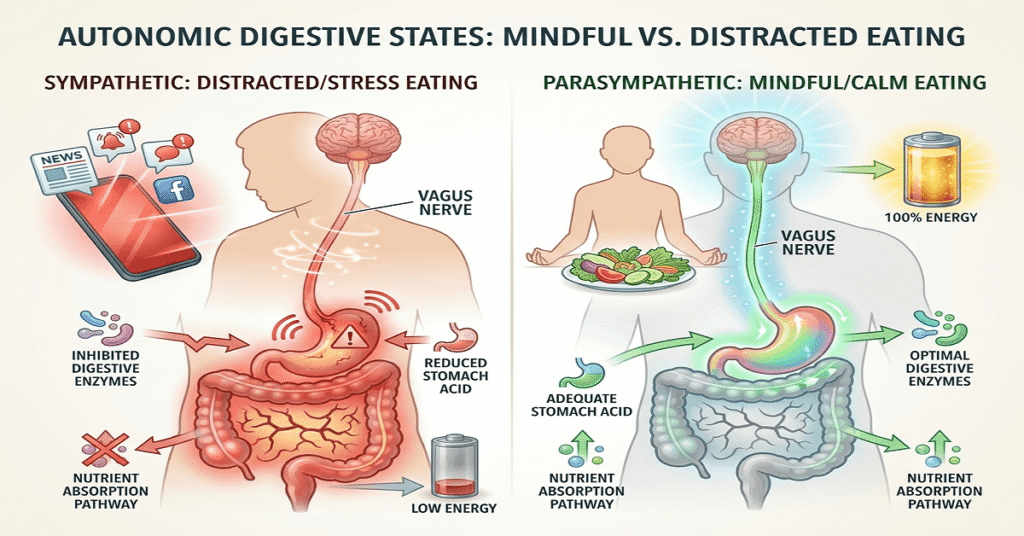
This is one of the most direct and immediately practical applications of mindfulness for gut health.
Eating quickly, while distracted, under stress, or while working activates sympathetic nervous system activity during digestion, the worst possible state for gut function. The gut needs parasympathetic activation to produce adequate digestive enzymes and stomach acid, and to maintain normal motility. Mindful eating for gut health:- Remove screens from all meals – phone, laptop, television
- Sit down and pause for 3 to 5 slow breaths before eating anything
- Chew each bite thoroughly before swallowing: aim for 20 to 30 chews for solid food
- Eat slowly enough to notice when you are comfortably full rather than overfull
How to Start - A Practical Entry Point
If you have never meditated or done structured breathwork, here is a realistic starting point that takes 15 minutes per day:
Morning (10 minutes):
- 5 minutes of resonance breathing (5 seconds in, 5 seconds out, use a pacing app)
- 5 minutes of body scan or mindful breathing
Before each meal (1 minute):
- 5 slow diaphragmatic breaths before eating
Total daily time: approximately 12 to 15 minutes
This is enough to produce measurable changes in vagal tone over 4 to 8 weeks of consistent practice.
Quick-Reference Summary
| Practice | Mechanism | Best For | Time Needed |
|---|---|---|---|
| Slow diaphragmatic breathing (extended exhale) | Activates parasympathetic, stimulates vagus nerve | IBS, post-meal bloating, stress-related gut symptoms | 5–10 min |
| Resonance (coherent) breathing | Maximizes vagal tone and HRV | Daily gut motility support, microbiome balance | 10–20 min |
| Humming breath (Bhramari) | Direct vagal stimulation via vibration | Acute gut distress, quick parasympathetic shift | 3–5 min |
| MBSR / mindfulness meditation | Reduces systemic inflammation, rebalances gut-brain axis | IBS, chronic gut inflammation, anxiety + gut | 10–45 min |
| Body scan meditation | Improves interoceptive awareness, reduces gut hypersensitivity | IBS, leaky gut, gut-brain dysregulation | 10–20 min |
| Mindful eating | Ensures digestion occurs in parasympathetic mode | All gut conditions: foundational | Per meal |
Frequently Asked Questions
Q: Can meditation physically improve gut health?
A: Yes, through measurable biological mechanisms. Meditation activates the parasympathetic nervous system, increases vagal tone, reduces cortisol, lowers systemic inflammation, and shifts gut function toward normal motility and reduced permeability. Multiple randomized controlled trials have demonstrated significant reductions in IBS symptom severity and inflammatory markers following consistent mindfulness-based practice.
Q: How does breathwork help digestion?
A: Slow diaphragmatic breathing (particularly with extended exhales) directly activates the vagus nerve, the primary nerve of the parasympathetic “rest and digest” system. When the vagus nerve is activated, blood flow returns to the gut, digestive enzyme production resumes, gut motility normalizes, and gut lining repair is supported. Even 5 minutes of slow breathing before a meal meaningfully shifts the body into a better state for digestion.
Q: How long before meditation improves gut symptoms?
A: Clinical research using 8-week MBSR programs shows meaningful symptom reductions at the end of the program but many practitioners report noticeable changes within 2 to 4 weeks of consistent daily practice.
Further Readings
For peer-reviewed research on mind-body practices and gut health: