Gut Health 101: The Complete Beginner's Guide

Disclaimer: This guide is for informational purposes only. It is not medical advice. Always talk to your doctor before making changes to your health routine.

What You Will Learn in This Guide

  • What gut health actually means
  • What the gut microbiome is and why it matters
  • How a healthy gut looks vs an unhealthy one
  • What hurts your gut every day (you may not realize it)
  • How your gut connects to your mood, skin, energy, and more
  • Simple, realistic first steps to start improving your gut today

Why I Wrote This Guide

When I first started having gut problems, I had no idea where to start. I searched online and got hit with a wall of confusing medical terms, conflicting advice, and articles that read like textbooks.

I am an IT professional. Not a doctor. Not a nutritionist. But I spent a long time reading, researching, and trying things on myself. And slowly, things got better.

This guide is what I wish someone had handed me at the beginning. No jargon. No scare tactics. Just the basics, clearly explained so you can actually understand what is going on inside your body and what you can do about it.

Let’s start from the very beginning.

What Is Gut Health?

Gut health is about how well your digestive system works.

That sounds simple. But your gut does a lot more than just break down food. It is one of the most important systems in your entire body.

When people talk about gut health, they usually mean:

  • How well food moves through your digestive system
  • How well your body absorbs nutrients from food
  • Whether your gut has a healthy balance of bacteria
  • How well your gut lining is holding up
  • How your gut is communicating with the rest of your body

Think of your gut as the engine of your body. When the engine runs well, everything works better. When it does not, you feel it everywhere.

What Is the Gut Microbiome?

Gut health is about how well your digestive system works.
That sounds simple. But your gut does a lot more than just break down food. It is one of the most important systems in your entire body.

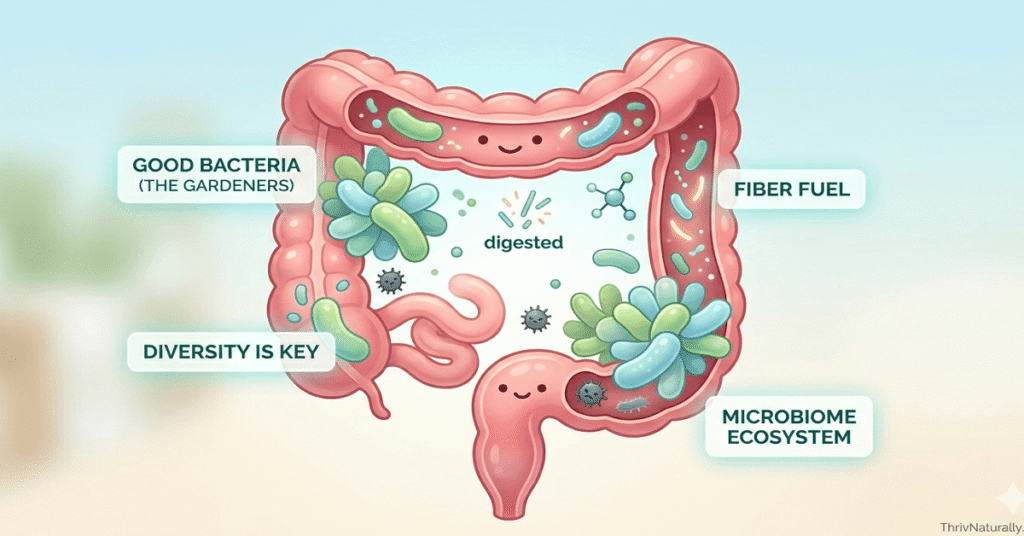
An educational infographic illustrating the gut microbiome as a balanced, blooming inner garden where colorful good bacteria outnumber bad bacteria.
Visualizing your microbiome as an ecosystem: diversity and balance are the keys to a thriving intestinal garden.

When people talk about gut health, they usually mean:

  • How well food moves through your digestive system
  • How well your body absorbs nutrients from food
  • Whether your gut has a healthy balance of bacteria
  • How well your gut lining is holding up
  • How your gut is communicating with the rest of your body

Think of your gut as the engine of your body. When the engine runs well, everything works better. When it does not, you feel it everywhere.

What Does a Healthy Gut Actually Look Like?

Most people think gut health just means “no stomach pain.” But it is much more than that.

Signs of a healthy gut include:

  • You have regular, comfortable bowel movements (once or twice a day is typical)
  • You do not feel bloated after normal meals
  • You have steady energy throughout the day
  • Your skin is clear and not inflamed
  • Your mood is generally stable
  • You do not get sick all the time
  • You can tolerate a wide variety of foods without discomfort

If most of those describe you, great!. Your gut is likely in decent shape.
If several of them do not describe you, keep reading. You are in the right place.

Signs Your Gut Is Unhealthy

This is one of the most important sections in this guide. Many gut problems are easy to miss because they look like “normal” things people just live with.

Here is a checklist. Go through each one honestly

Digestive signs:

  • [ ] Bloating after most meals
  • [ ] Frequent gas or burping
  • [ ] Constipation (less than 3 bowel movements a week)
  • [ ] Diarrhea, loose stools, or unpredictable bathroom habits
  • [ ] Stomach cramps or pain after eating
  • [ ] Heartburn or acid reflux
  • [ ] Feeling like food sits in your stomach for hours

Energy and mental signs:

  • [ ] Constant fatigue even after a full night of sleep
  • [ ] Brain fog (trouble concentrating or thinking clearly)
  • [ ] Mood swings or feeling anxious without a clear reason
  • [ ] Trouble sleeping
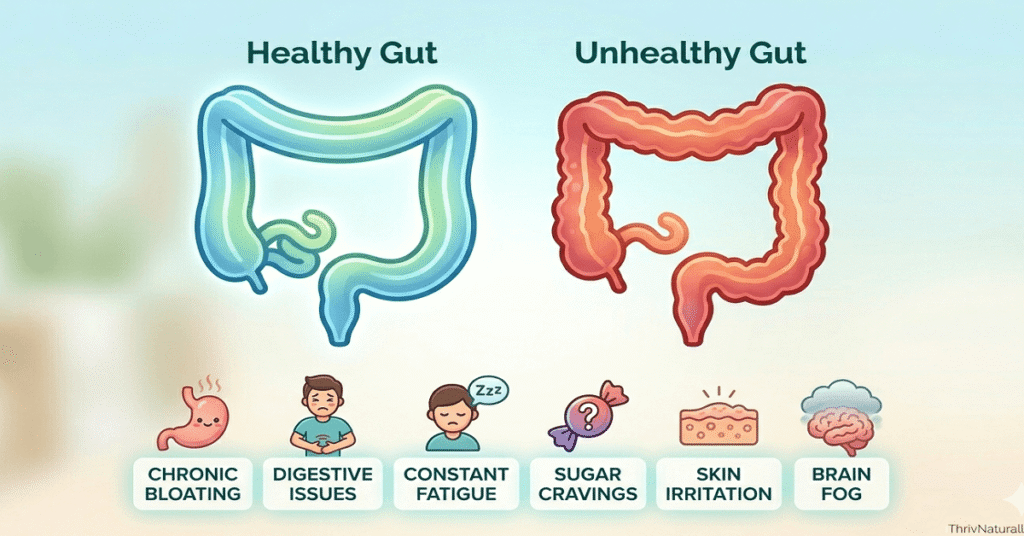
An infographic checklist illustrating systemic signs of gut imbalance, contrasting a healthy gut icon with symptoms like bloating, fatigue, brain fog, and sugar cravings.
Your body speaks gut health: recognizing the common signals of microbiome imbalance.

Other body signs:

  • [ ] Skin problems (acne, eczema, rashes, or dull skin)
  • [ ] Getting colds or infections more often than others
  • [ ] Food intolerances that seem to be getting worse over time
  • [ ] Unexplained weight gain or trouble losing weight

If you checked three or more boxes, your gut likely needs some attention. The good news is that most of these can improve with the right changes. This whole site is about those changes.

What Damages Your Gut?

Here is something that surprised me when I first learned it: a lot of everyday habits quietly damage the gut over time.

Most people have no idea they are doing it.

1. A Diet Full of Processed Foods

Ultra-processed foods are the biggest threat to gut health today.

These are foods that come in a package with a long list of ingredients (refined sugars, artificial sweeteners, seed oils, emulsifiers, preservatives, artificial colors).

These ingredients do two things to your gut:

  • They feed harmful bacteria and allow them to overgrow
  • They reduce the diversity of your good gut bacteria

Research consistently shows that people who eat more whole, unprocessed foods have more diverse and healthier gut microbiomes. People who eat a lot of processed food have the opposite.

You do not have to give up everything you enjoy. But if packaged, processed food makes up most of your diet, your gut microbiome is probably suffering for it.

2. Antibiotics (When Overused)

Antibiotics save lives. They are necessary and important.

But they are also one of the most powerful disruptors of the gut microbiome. When you take antibiotics, they do not just kill the harmful bacteria causing your infection. They wipe out huge sections of your good bacteria too.

This is called antibiotic-associated dysbiosis when the balance of your gut bacteria is disrupted by medication.

After a course of antibiotics, it can take months for your gut microbiome to recover and for some people, it never fully returns to where it was before.

This does not mean you should avoid antibiotics when you genuinely need them. It means being thoughtful about rebuilding your gut afterwards. We cover this in a separate guide.

See: Gut Health After Antibiotics: How to Restore Your Microbiome

3. Chronic Stress

I felt this one personally. During some stressful seasons of my life, my gut was a mess. I did not make the connection for a long time. But the science is clear: stress directly disrupts gut function. When you are stressed, your body releases cortisol and other stress hormones. These hormones:
  • Slow digestion down or speed it up unpredictably
  • Change the composition of your gut bacteria
  • Increase gut permeability (more on this below)
  • Trigger inflammation in the gut lining
Chronic stress (the kind that goes on for weeks, months, or years) is one of the most underrated causes of gut problems. We will explore the gut-stress connection more in the Gut-Brain Connection guide.

See: The Gut-Brain Connection

4. Poor Sleep

Most people know that poor sleep makes them feel terrible. Fewer people know it also damages their gut.

Your gut microbiome follows a daily rhythm similar to your body’s sleep-wake cycle. When you consistently get bad sleep, that rhythm gets disrupted.

Studies have found that even two nights of poor sleep can measurably reduce gut microbiome diversity. Over time, poor sleep and poor gut health create a vicious cycle each one making the other worse.

5. Lack of Dietary Fiber

The average American eats around 15 grams of fiber per day. The recommended amount is 25–38 grams. Most people are getting less than half of what their gut needs.

When good bacteria do not get enough fiber, they start to die off. Harmful bacteria, which do not need fiber, fill the space. The balance shifts in the wrong direction.

The fix is not complicated – eat more plants. We cover this in depth in the Gut-Healing Diet guide.

See: Gut Health Diet – What to Eat, What to Avoid

6. Alcohol

Alcohol disrupts the gut in multiple ways. It:

  • Damages the gut lining directly
  • Alters the composition of gut bacteria
  • Increases gut permeability (leaky gut)
  • Promotes growth of harmful bacteria

Occasional moderate drinking is unlikely to cause lasting damage. But regular or heavy drinking is a significant gut health risk.

Your Gut and the Rest of Your Body

This is the part that really opened my eyes when I first learned it. Your gut does not just affect your digestion. It affects almost everything.

Gut Health and Your Immune System

About 70–80% of your immune system lives in and around your gut. The gut microbiome literally trains your immune cells to tell the difference between threats and harmless substances.

When your gut microbiome is damaged, your immune system becomes less accurate. It may:

  • Overreact to things that are not actually harmful (allergies, food intolerances)
  • Fail to respond strongly enough to things that are harmful (frequent infections)
  • Start attacking the body itself (autoimmune conditions)

Taking care of your gut is one of the most direct ways to support your immune system.

Gut Health and Your Mood

Your gut produces roughly 90% of your body’s serotonin (the chemical most closely linked to mood and emotional well-being). Let that sink in. Ninety percent. Not in your brain. In your gut. Your gut also communicates with your brain constantly through a direct pathway called the vagus nerve. The gut sends far more signals to the brain than the brain sends back. Read more about it in this NLM article. This is why people with poor gut health often experience anxiety, low mood, and irritability even when there is no obvious reason for it in their life.

See: The Gut-Brain Connection: How Your Gut Affects Your Mood and Mind

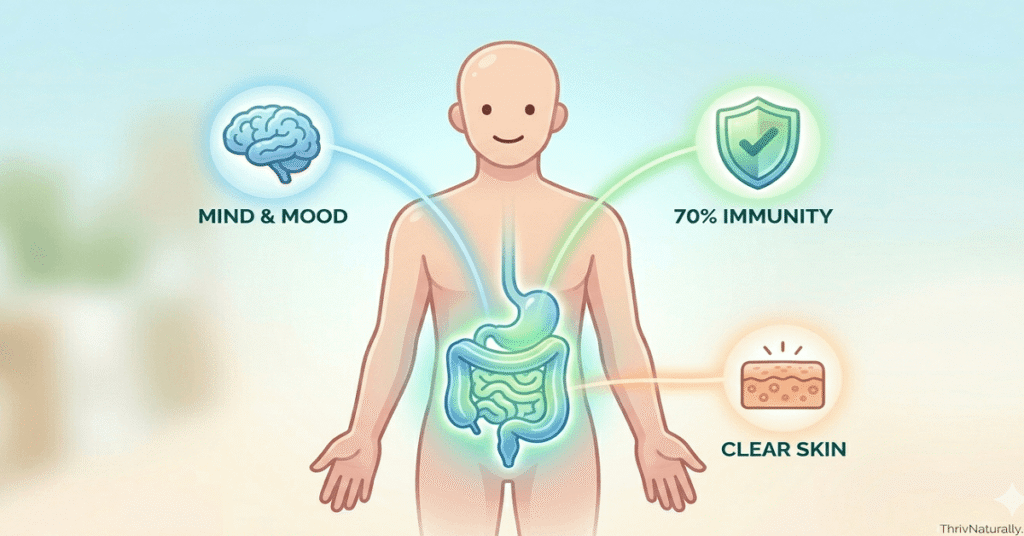
An infographic illustrating how the gut communicates with the rest of the body, showing light pathways connecting a highlighted microbiome to icons for the Brain, Immune System, and Skin.
Systemic communication: how a balanced microbiome supports your mind, mood, immune resilience, and even your skin.

Gut Health and Your Skin

If you have ever noticed that your skin gets worse when your digestion is off, you are not imagining it.

The gut and skin are connected through what researchers call the gut-skin axis. When your gut microbiome is imbalanced, it triggers systemic inflammation (inflammation that can show up on your skin as acne, eczema, rosacea, or dullness).

Many people who have struggled with skin issues for years see significant improvement simply by improving their gut health.

Gut Health and Your Energy

Your gut is responsible for absorbing the nutrients your body needs to make energy – vitamins, minerals, amino acids.

When the gut lining is damaged or inflamed, it does not absorb nutrients properly. Your body runs low on the raw materials it needs. The result? Constant fatigue that sleep does not fix.

The Most Common Gut Health Problems

Before we get to solutions, it helps to understand what can go wrong. Here are the most common gut health conditions people deal with.

Gut Dysbiosis

Dysbiosis just means your gut bacteria are out of balance – too many harmful bacteria, not enough good ones.

It is the root cause of most gut health problems. It can be caused by any combination of the factors listed above such as poor diet, antibiotics, stress, poor sleep.

IBS (Irritable Bowel Syndrome)

IBS affects roughly 10–15% of Americans. It is characterized by a mix of constipation, diarrhea, bloating, and stomach cramps often triggered by specific foods or stress.

IBS is a diagnosis of exclusion, meaning doctors rule out other conditions before landing on it. The gut microbiome plays a significant role in IBS.

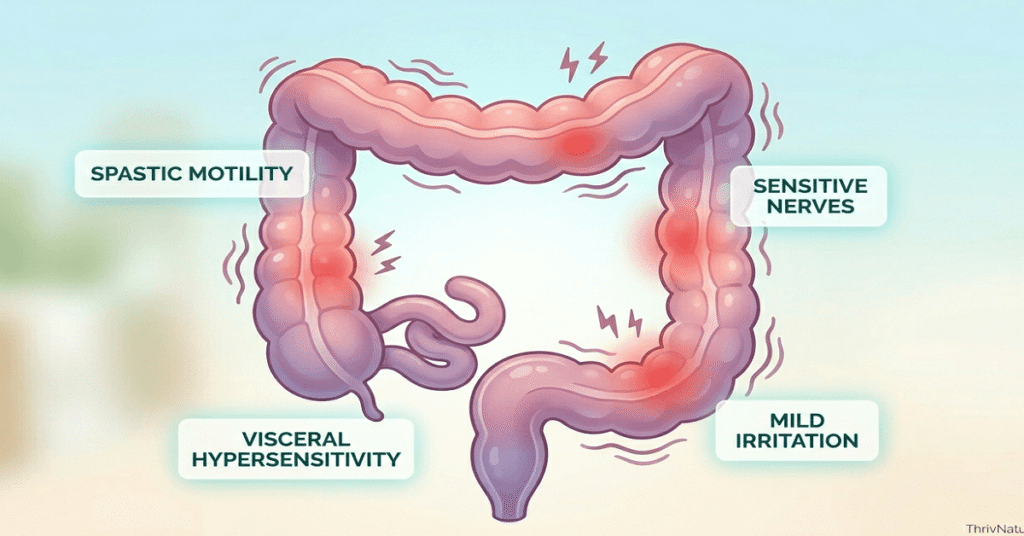
A medical illustration visualizing Irritable Bowel Syndrome (IBS), showing an irregular, spastic colon with icons indicating nerve sensitivity and irritation.
Visualizing IBS: Irritation and spastic motility in the colon can disrupt normal function and cause discomfort.

Leaky Gut (Intestinal Permeability)

Your gut lining is a barrier. Its job is to let nutrients through into your bloodstream while keeping harmful substances out.

When that lining gets damaged, the barrier becomes less effective. Tiny gaps form. Substances that should stay in the gut start leaking through triggering inflammation and immune responses throughout the body.

This is commonly called “leaky gut.” Officially, it is known as increased intestinal permeability.

See: Leaky Gut Symptoms and How to Heal Naturally

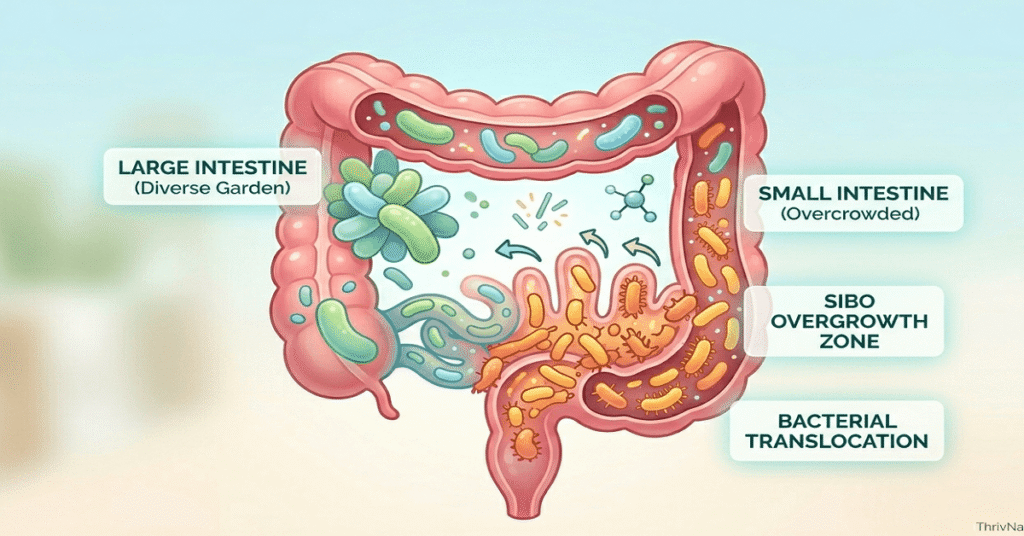
SIBO (Small Intestinal Bacterial Overgrowth)

SIBO happens when bacteria that normally live in the large intestine migrate into the small intestine, where they do not belong.

It causes bloating, gas, and digestive distress often within minutes of eating. It is more common than most people realize and is frequently misdiagnosed as IBS.

An educational diagram visualizing SIBO, showing the small intestine overgrown with dense, misplaced bacteria, contrasting against the diverse garden of the large intestine.
Location matters: SIBO occurs when the small intestine becomes overcrowded with misplaced bacteria, disrupting the delicate microbial balance.

See: What Is SIBO and Do You Have It?

Your First Steps to Better Gut Health

Here is the part you have been waiting for.

You do not need to overhaul your entire life to start seeing improvement. Small changes, done consistently, add up fast when it comes to gut health.

Here are five first steps that are backed by solid research and actually make a difference.

Step 1: Add More Fiber to Every Meal

You do not need to calculate grams or track macros. Just ask yourself at every meal: “Is there a plant on this plate?”

Vegetables, fruits, legumes, whole grains, nuts, and seeds are all fiber sources your gut bacteria need. Aim to add at least one to every meal you eat. Simple.

See: High-Fiber Foods for Gut Health: A Practical Grocery Store Guide

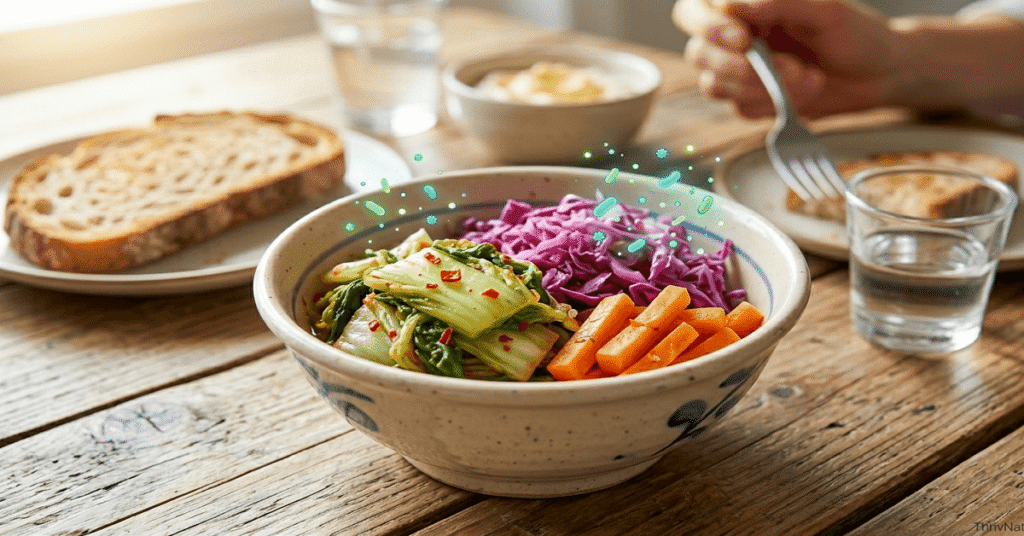
Step 2: Eat At Least One Fermented Food Every Day

Fermented foods are packed with live bacteria that add to your gut microbiome diversity.

The best options for most Americans:

  • Plain yogurt with live cultures
  • Kefir (drinkable yogurt)
  • Sauerkraut (look for the refrigerated kind, not the shelf-stable kind)
  • Kimchi
  • Kombucha (low-sugar varieties)

Start with one small serving a day. Your gut may take a week or two to adjust if you are not used to fermented foods.

See: The Best Probiotic Foods to Eat Every Day

A close-up photograph of a colorful ceramic bowl filled with assorted fermented foods (kimchi, purple sauerkraut) on a sunlit wooden breakfast table.
The daily ritual: a small bowl of traditional ferments is an easy and delicious step toward nourishing your microbiome garden.

Step 3: Cut Back on Ultra-Processed Food

You do not need to eat perfectly. But try to replace one or two processed foods you eat regularly with whole-food alternatives.

Swapping a bag of chips for some nuts. Like replacing soda with sparkling water. Having yogurt instead of a packaged snack. These small trades add up.

See: The Gut Health Diet – What to Eat, What to Avoid

Step 4: Take Stress Seriously

If you are under chronic stress and wondering why your gut is not getting better, this is likely a big part of the answer.

Stress management is not a “nice to have” for gut health. It is essential. Even simple practices like 10 minutes of walking daily, getting outside, or basic breathing exercises can meaningfully reduce the cortisol that disrupts your gut.

See: How to Calm Your Nervous System to Heal Your Gut

Step 5: Protect Your Sleep

Sleep is when your gut repairs and rebalances. Without quality sleep, other gut health efforts are working against a headwind.

Aim for 7–8 hours. Keep a consistent sleep and wake time. Reduce screen exposure in the hour before bed. These basics matter more than most supplements ever will.

See: How Poor Sleep Destroys Your Gut – and What to Do

Quick-Reference Summary

TopicKey Takeaway
What is gut health?How well your digestive system works and whether it supports the rest of your body
Gut microbiomeTrillions of bacteria in your gut that affect digestion, immunity, mood, and more
Signs of unhealthy gutBloating, fatigue, brain fog, skin issues, frequent illness, mood swings
What damages your gutProcessed food, antibiotics, chronic stress, poor sleep, lack of fiber, alcohol
Gut-body connectionsImmune system, mood, skin, energy levels
Common conditionsDysbiosis, IBS, leaky gut, SIBO
First stepsMore fiber, fermented foods, less processed food, stress management, better sleep

Frequently Asked Questions

Q: How long does it take to improve gut health?

A: It depends on how damaged your gut is and what changes you make. Some people notice improvements in energy and digestion within 2–4 weeks of improving their diet. More significant changes to the gut microbiome typically take 2–3 months of consistent effort. There is no overnight fix, but progress comes faster than most people expect.

Q: Do I need to take probiotic supplements to heal my gut?

A: Not necessarily. Food-based sources of probiotics (yogurt, kefir, fermented vegetables) are often just as effective and more sustainable than supplements. Supplements have their place, but most people get meaningful results from diet changes alone.

See: Best Gut Health Supplements – What Works and What Does Not

Q: Can gut health affect my mental health?

A: Yes, significantly. Your gut produces about 90% of your body’s serotonin and communicates constantly with your brain through the vagus nerve. Poor gut health is strongly linked to anxiety, low mood, and brain fog. Improving gut health can have a real, measurable positive effect on how you feel mentally.

Q: What is the single most important thing I can do for my gut health?

A: Eat more plants. Specifically, more fiber from a variety of different vegetables, fruits, legumes, and whole grains. Fiber feeds good gut bacteria. Nothing else has as consistent and well-supported an impact on gut microbiome health as dietary fiber diversity.

Q: Is gut health the same as digestive health?

A: They overlap but are not identical. Digestive health mostly refers to how well food is broken down and moved through your system. Gut health is broader – it includes the microbiome, the gut lining, gut-immune interactions, and the gut-brain connection. Think of digestive health as one part of the bigger gut health picture.

What to Read Next

You have got the foundation. Here is where to go from here depending on what matters most to you right now: