
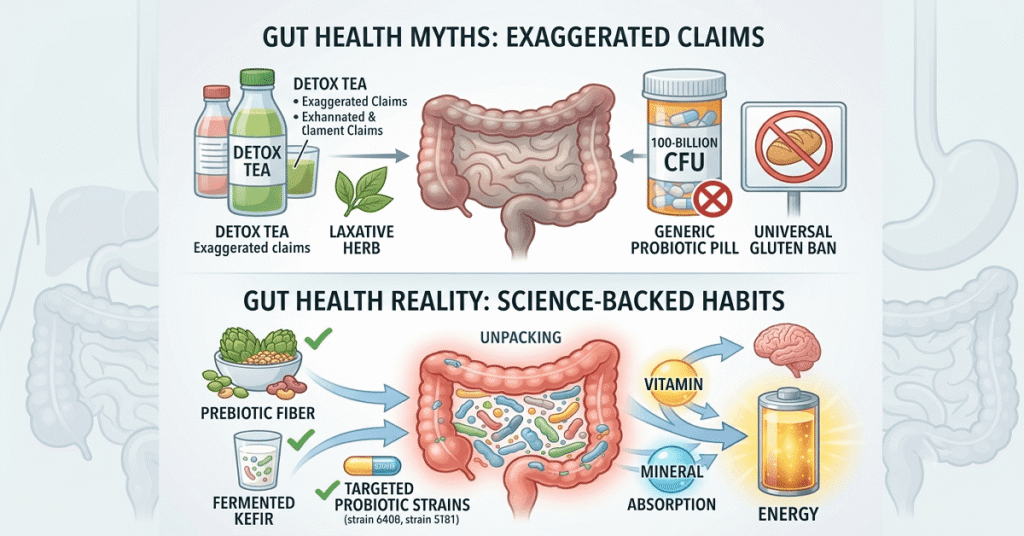
When I started researching gut health, I ran into a lot of confident-sounding advice that turned out to be wrong.
Some of it came from wellness blogs. Some from supplement companies. Some from well-meaning friends. And a surprising amount came from things I had just assumed were true without ever questioning.
The gut health space has a misinformation problem. It is a topic that people care deeply about which means it attracts a lot of oversimplified claims, half-truths, and flat-out myths.
Getting these wrong costs you time, money, and sometimes your health.
So let’s clear them up here.
Myth 1: "If You Have No Digestive Symptoms, Your Gut Is Fine"
This is probably the most common gut health misconception and one of the most harmful.
Many people with significant gut microbiome imbalance (dysbiosis) have no obvious digestive symptoms at all. The effects show up elsewhere: persistent fatigue, anxiety, skin problems, frequent illness, brain fog, difficulty managing weight.
The gut does not announce its problems the way a headache does. It communicates through subtle, often easily-dismissed signals that spread across the body.
Gut health is not just about digestion. It affects the immune system, the brain, the skin, and hormone regulation. You can have poor gut health without a single stomach complaint.
The reality: Digestive symptoms are one sign of poor gut health; not the only one.
See: Signs Your Gut Is Unhealthy – A Checklist to Assess Yourself
Myth 2: "You Need to Do a Gut Cleanse or Detox"
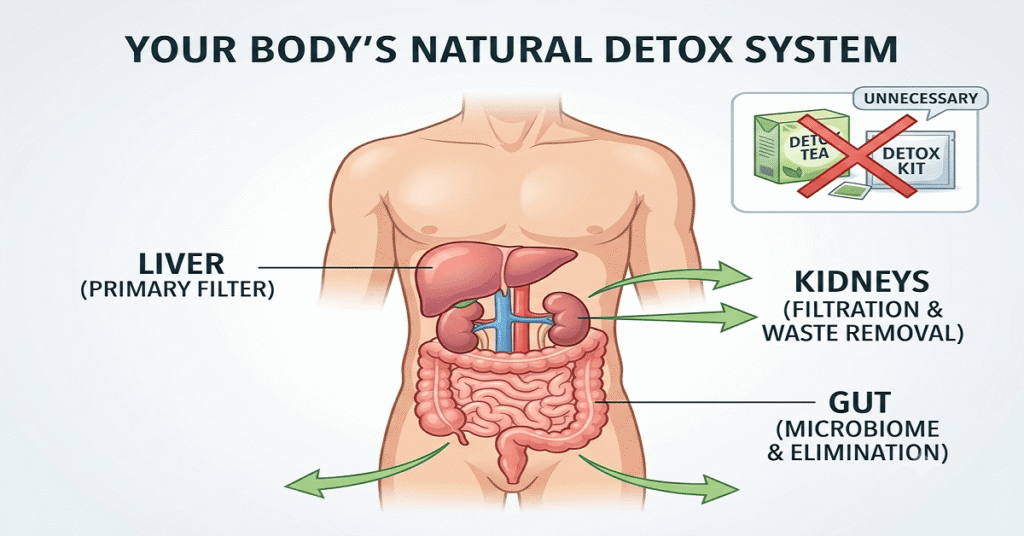
Walk into any health store or scroll through wellness Instagram and you will find gut cleanses everywhere. Teas. Juices. Multi-day programs. All promising to “flush out toxins” and reset your digestive system.
Here is the truth: your body already has a detoxification system. It is called your liver and kidneys. They work continuously, every day, without any help from a cleanse product.
Your gut does not store toxins waiting to be flushed out. And most cleanse products contain senna (a laxative herb that causes short-term bowel movements but does nothing for the microbiome and can cause dependency with regular use).
The closest thing to a genuine gut reset is simply improving your diet. More fiber-rich plants, fermented foods, less processed food. No product required.
The reality: There is no credible scientific evidence for gut cleanses. Your gut needs better food; not a detox kit.
Myth 3: "More Probiotics Are Always Better"
More bacteria. Higher CFU counts. Bigger bottles. Surely more is better, right?
Not exactly.
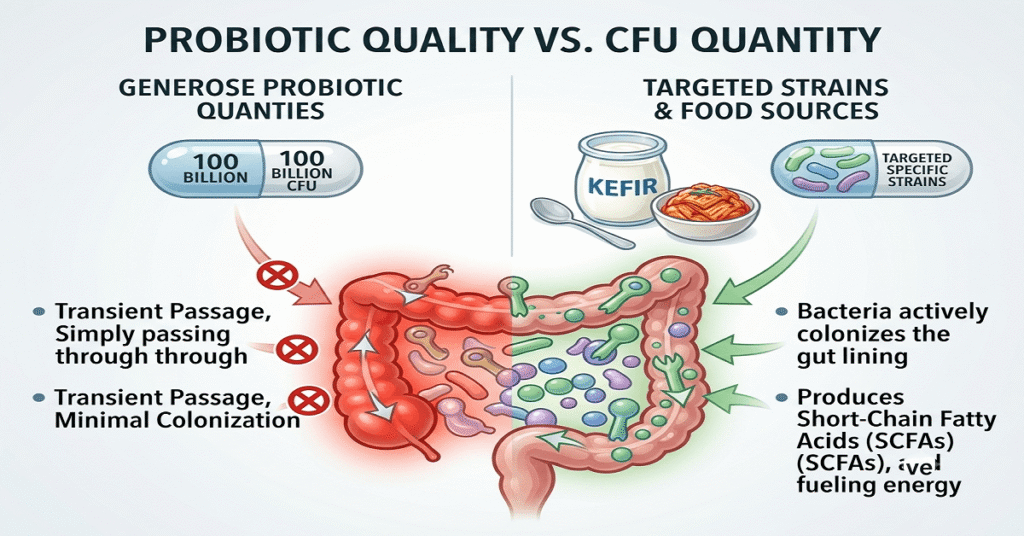
First, CFU (colony-forming units) count is not the most important factor in probiotic quality. Strain specificity matters far more than quantity. A probiotic with 5 billion CFU of a well-researched, relevant strain can outperform one with 100 billion CFU of poorly chosen strains.
Second, your gut has limited “real estate.” Adding enormous quantities of bacteria does not guarantee they stay or colonize. Most probiotic bacteria are transient (they pass through and provide benefit while they are present), then leave. The idea that you are permanently populating your gut with each capsule is mostly marketing.
Third, for some people with certain gut conditions like SIBO (small intestinal bacterial overgrowth), some probiotics can actually worsen symptoms if taken at the wrong time or in the wrong form.
The reality: More is not better with probiotics. Strain relevance, quality, and timing matter more than CFU count. Food-based probiotics from yogurt, kefir, and fermented vegetables are often more effective than high-dose supplements.
Myth 4: "Gluten Is Bad for Everyone's Gut"
The anti-gluten movement has created the impression that gluten is universally harmful to the gut. The reality is more nuanced.
For people with celiac disease gluten causes serious, measurable intestinal damage. Avoiding gluten is medically essential for this group.
For people with non-celiac gluten sensitivity gluten can cause digestive symptoms and discomfort without the intestinal damage seen in celiac disease.
For people without either condition the evidence does not support avoiding gluten for gut health reasons. In fact, whole grains containing gluten (like wheat, barley, and rye) provide prebiotic fiber that feeds beneficial gut bacteria. Unnecessarily cutting them out can actually reduce microbiome diversity.
The widespread adoption of gluten-free diets among people who do not need them has not been shown to improve gut health and in some cases it leads to lower fiber intake and worse microbiome outcomes.
The reality: Gluten is a problem for people with celiac disease and some with gluten sensitivity. For everyone else, whole grain sources of gluten can support gut health through their prebiotic fiber content.
Myth 5: "Probiotic Supplements Are the Best Way to Improve Your Gut Microbiome"
This is one the supplement industry works hard to perpetuate.
Probiotic supplements do have a place particularly for rebuilding after antibiotics, for specific conditions like IBS-D, and for targeted strain-based interventions. The research on them is real and worth taking seriously.
But they are not the best way to improve your gut microbiome in the everyday sense.
The most impactful thing you can do for your gut microbiome is eating a diet rich in diverse plant foods and fermented foods. A 2021 Stanford study found that a high-fermented-food diet increased microbiome diversity more effectively than a high-fiber diet alone. Diet is the primary driver of gut microbiome health.
Supplements are useful additions on top of a good diet. Remember they are not substitutes for it.
The reality: Diverse plants and fermented foods are more powerful gut microbiome builders than probiotic supplements. Supplements support a good diet; they do not replace it.
Myth 6: "Gut Health Problems Are Just IBS"
When people mention gut health struggles to a doctor and everything comes back normal on standard tests, the frequent response is an IBS diagnosis or simply being told to manage stress and eat better.
IBS is real. But it is one of many gut health conditions, not a catch-all for everything gut-related.
Other conditions that are commonly missed or misdiagnosed include:
- SIBO (small intestinal bacterial overgrowth): present in an estimated 30 to 80 percent of IBS cases, but requires a specific breath test to diagnose
- Leaky gut (increased intestinal permeability): no standard clinical test exists yet, making it easy to dismiss
- Gut dysbiosis: standard tests do not screen for microbiome imbalance
- Food intolerances: lactose and fructose malabsorption are common and often undiagnosed
Treating everything as IBS when other conditions may be present leads to management strategies that do not address the real issue.
The reality: IBS is one gut condition among many. If your IBS treatment is not working, it is worth investigating whether another condition might be contributing.
See: Common Gut Health Conditions – Symptoms, Causes, and Natural Relief
Myth 7: "Gut Health Only Affects Digestion"
We covered this in the body systems post, but it is worth repeating here because it is perhaps the most limiting belief in the whole gut health space.
Your gut microbiome influences:
- Your immune system – 70 to 80 percent of which lives in the gut
- Your brain – through the gut-brain axis, serotonin production, and vagus nerve signaling
- Your skin – through the gut-skin axis and systemic inflammation
- Your energy levels – through nutrient absorption and inflammation
- Your weight – through hunger hormones, insulin sensitivity, and calorie extraction
- Your hormones – through estrogen metabolism and cortisol regulation
Thinking of gut health as purely a digestive topic is one of the reasons people dismiss it or address only the most obvious symptoms without looking at the bigger picture.
The reality: Gut health is whole-body health. The gut microbiome communicates with and influences nearly every major system in your body.
Myth 8: "Gut Health Takes Months to Improve ; There Is No Point Trying"
This one is less a myth about what gut health is and more a myth about what is possible and it stops a lot of people from starting.
The gut microbiome is remarkably responsive to change. Research shows it begins responding to dietary improvements within 24 to 72 hours.
That does not mean everything resolves in three days. Significant improvements in microbiome diversity and gut lining integrity take 2 to 3 months of consistent effort. Chronic conditions take longer.
But many people notice real, tangible improvements in digestion, energy, and bloating within 2 to 4 weeks of making meaningful changes. [Not perfection but noticeable progress]. Enough to know the changes are working and to keep going.
The reality: The gut microbiome responds to dietary changes faster than almost any other biological system. You can feel meaningful improvement within weeks not years.
Myth 9: "You Have to Eat Perfectly to Have Good Gut Health"
Perfectionism is the enemy of consistency and consistency is what actually changes your gut.
The gut microbiome is resilient. One bad meal does not undo a week of good eating. A slice of birthday cake does not wreck your microbiome. A stressful week does not permanently damage your gut health.
What matters is the overall pattern – the habitual, day-to-day baseline of what you eat and how you live. Not the occasional exception.
Pursuing dietary perfection often backfires. It creates stress (which is itself damaging to the gut). It creates a binary all-or-nothing mentality that leads to giving up entirely after one deviation.
The reality: Small, consistent improvements over time produce far better gut health outcomes than attempts at perfection.
Myth 10: "Fermented Foods Are Just a Trend"
Fermented foods (yogurt, kefir, kimchi, sauerkraut, miso, tempeh, kombucha) have been dismissed by some as a wellness trend without scientific backing.
This is wrong.
A landmark 2021 randomized clinical trial from Stanford researchers published in Cell found that a high-fermented-food diet increased gut microbiome diversity and reduced markers of systemic inflammation more effectively than a high-fiber diet over a 10-week period. These are hard endpoints, measurable changes in microbial diversity and immune markers.
Fermented foods have also been part of traditional diets across virtually every culture in the world for thousands of years long before anyone knew what a microbiome was. There is a reason they persisted: they work.
The reality: Fermented foods are one of the most evidence-backed dietary interventions for gut microbiome health.
Quick-Reference Summary
| Myth | Reality |
|---|---|
| No digestive symptoms = healthy gut | Gut problems often show up as fatigue, anxiety, skin issues, not just digestion |
| Gut cleanses reset your system | No evidence for cleanses; your liver and kidneys handle detoxification |
| More probiotics = better results | Strain specificity and diet matter more than CFU count |
| Gluten is bad for everyone | Only harmful for celiac disease and some with sensitivity; whole grains support the microbiome |
| Supplements are the best gut fix | Diverse plants and fermented foods outperform supplements consistently |
| All gut issues are IBS | SIBO, leaky gut, dysbiosis, and food intolerances are commonly missed |
| Gut health is only about digestion | Gut health affects immunity, brain, skin, energy, weight, and hormones |
| Gut improvement takes months | Changes begin within 72 hours; noticeable improvements within weeks |
| You need to eat perfectly | Consistent small improvements beat sporadic perfection |
| Fermented foods are a trend | Strong clinical evidence; part of human diets for thousands of years |
Frequently Asked Questions
Q: What is the biggest myth about gut health?
A: One of the most widespread gut health myths is that digestive symptoms are the only sign of a gut problem. In reality, poor gut microbiome health commonly manifests as fatigue, brain fog, anxiety, skin problems, and frequent illness without any obvious digestive symptoms. Many people with significant gut dysbiosis do not experience bloating or stomach pain at all.
Q: Are gut cleanses effective?
A: No, there is no credible scientific evidence that gut cleanses or detox programs improve gut health. Most cleanse products contain senna, a laxative herb that causes bowel movements but does not benefit the microbiome. Your liver and kidneys handle detoxification continuously. The most effective gut reset is improving your diet (more fiber-rich plants, fermented foods, and less processed food) without any commercial product.
Q: Is gluten bad for gut health?
A: Only for people with celiac disease or non-celiac gluten sensitivity. For everyone else, whole grain sources of gluten (wheat, barley, rye) provide prebiotic fiber that supports gut bacteria. Unnecessarily avoiding gluten can reduce fiber intake and harm microbiome diversity. If you suspect gluten sensitivity, get tested for celiac disease before eliminating it.
Q: Do probiotic supplements actually work?
A: Probiotic supplements work for specific purposes (particularly post-antibiotic recovery, IBS symptom management, and targeted strain-based interventions). But they are not the most effective way to improve gut microbiome health generally. Diverse plant foods and fermented foods have stronger evidence for improving microbiome diversity and reducing inflammation.
Disclaimer: This post is for informational purposes only and is not medical advice. If you have persistent gut symptoms, please consult a qualified healthcare provider.