
What Is the Gut Microbiome? A Plain-English Explanation
You have probably heard the word “microbiome” thrown around a lot lately. It shows up on yogurt labels, supplement bottles, and wellness blogs everywhere.
But what does it actually mean?
When I first came across the term, I had no idea. I nodded along like I understood it, then quietly searched it later :-/. And honestly the explanations I found were either way too scientific or way too vague to be useful.
So here is the version I wish I had found. What it is, what it does, and why it matters to how you feel every single day.
The Simple Version First
Your gut microbiome is the community of tiny living organisms inside your digestive system.
We are talking about bacteria, fungi, viruses, and other microbes (trillions of them) living mostly in your large intestine.
Most of them are not harmful. In fact, most of them are helpful. They work with your body to digest food, make certain vitamins, protect against illness, and communicate with your brain.
When that community is diverse and balanced, your body works well. When it is disrupted or out of balance, you feel it often in ways that seem completely unrelated to digestion.
That is the gut microbiome in a nutshell. Now let’s go a level deeper.
How Many Microbes Are We Actually Talking About?
The numbers are genuinely staggering.
Your gut is home to approximately 39 trillion microbial cells. That is roughly the same number as the total human cells in your body.
Put another way: for every one cell that is “you,” there is approximately one microbial cell living alongside it.
There are also around 1,000 different bacterial species that can live in the human gut though each person carries a unique mix of them. No two people have exactly the same gut microbiome, just like no two people have the same fingerprint.
These microbes collectively carry about 150 times more genes than the human genome itself. Researchers sometimes call the microbiome a “second genome”, it carries that much genetic information.
What Does the Gut Microbiome Actually Do?
This is where it gets interesting.
Most people think your gut is just a machine for digesting food. You eat, your body takes in the good stuff, and the rest gets tossed out. Right?
No. Your gut microbiome is involved in processes that affect your entire body.
It Helps Digest Food You Cannot Digest Yourself
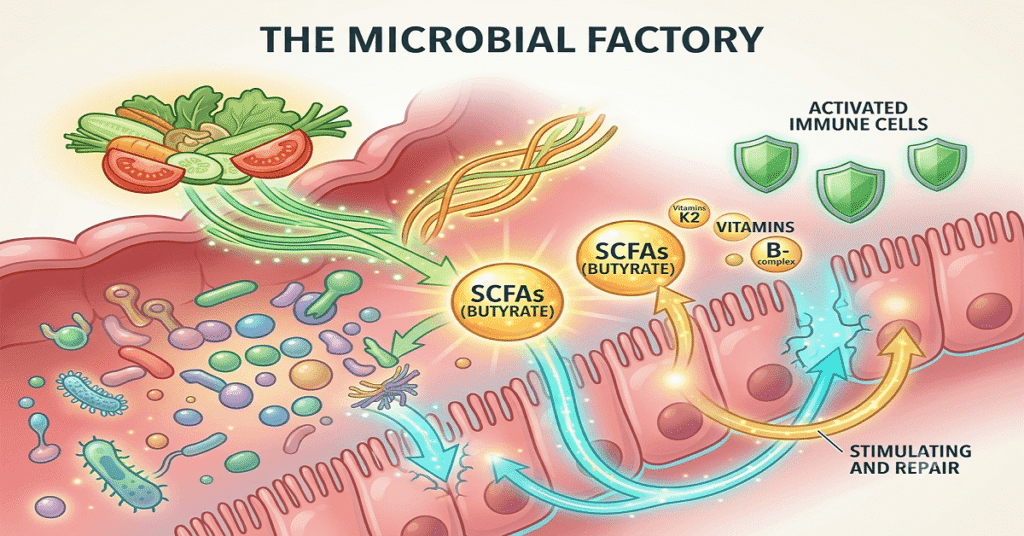
Your body cannot break down certain types of fiber on its own. But your gut bacteria can.
When bacteria ferment dietary fiber (from vegetables, fruits, legumes, and whole grains) they produce compounds called short-chain fatty acids (SCFAs). Butyrate, propionate, and acetate are the main ones.
These SCFAs do a lot of important work:
- They feed and maintain the cells lining your gut
- They reduce inflammation in the digestive tract
- They signal to the immune system
- They cross into the bloodstream and travel to the brain, where they influence mood and cognition
This is one reason why fiber is so important for gut health not just for bowel regularity, but because it feeds the bacteria that produce these beneficial compounds.
It Produces Vitamins Your Body Needs
Your gut bacteria produce several vitamins that your body cannot make on its own in sufficient amounts. These include:
- Vitamin K2: important for bone health and cardiovascular function
- B vitamins: including B12, folate, and biotin, which are essential for energy, nerve function, and cell production
When your gut microbiome is disrupted, vitamin production can drop contributing to deficiencies that affect energy, mood, and overall health.
It Trains and Supports Your Immune System
About 70 to 80 percent of your immune system lives in and around your gut.
This is not a coincidence. The gut is the largest point of contact between your body and the outside world everything you eat passes through it. Your immune system needs to be right there, deciding what is safe and what is a threat.
Your gut bacteria play a direct role in training immune cells to make that distinction accurately. A diverse, healthy microbiome helps your immune system respond appropriately. When the microbiome is disrupted, the immune system can become either overactive attacking harmless things like certain foods or underactive, failing to defend against actual pathogens.
It Communicates With Your Brain
This one surprised me the most when I first learned about it.
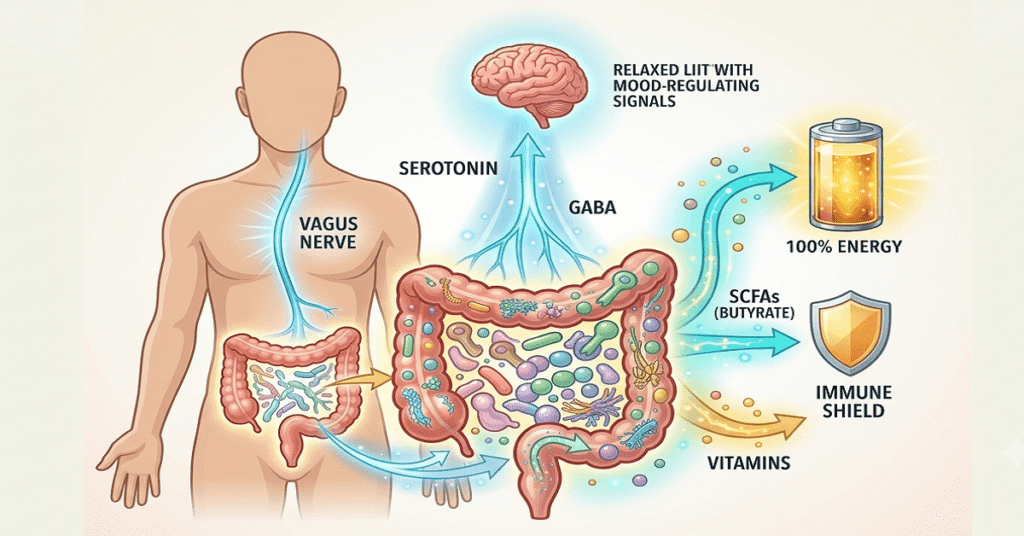
Your gut and brain are in constant two-way communication through a pathway called the gut-brain axis. The main cable in that pathway is the vagus nerve – and about 80 to 90 percent of the signals traveling on it go from the gut upward to the brain, not the other way around.
Your gut bacteria are directly involved in this communication. They influence the production of serotonin, the mood-regulating neurotransmitter most associated with emotional well-being. In fact, about 90 percent of the body’s serotonin is made in the gut.
They also produce GABA, a calming brain chemical, and influence dopamine production.
This is why people with poor gut microbiome health so often experience anxiety, low mood, and brain fog alongside their digestive symptoms. The connection is direct and biological not just stress-related.
See: The Gut-Brain Connection – How Your Gut Affects Your Mood and Mind
What Affects the Gut Microbiome?
Your gut microbiome is not fixed. It changes constantly responding to what you eat, how you sleep, how stressed you are, and what medications you take.
Things that help it:
- A diverse diet with lots of different plants
- Fermented foods (yogurt, kefir, kimchi, sauerkraut) which add live bacteria
- Adequate sleep (the microbiome follows a circadian rhythm tied to your sleep cycle)
- Regular physical activity
- Time in nature: exposure to a wider range of environmental microbes
Things that hurt it:
- A diet high in ultra-processed foods and sugar
- Antibiotics necessary when needed, but they wipe out significant portions of gut bacteria alongside the harmful ones
- Chronic stress directly alters microbiome composition over time
- Poor sleep
- Excessive alcohol
- Low dietary fiber intake
The good news is that your gut can start feeling better pretty quickly when you make healthy changes. In fact, eating better foods can start changing your gut bugs in just 1 to 3 days! If you stick with those good habits for 2 to 4 weeks, you’ll start seeing real, lasting results.
What Is a Healthy Gut Microbiome?
Two things define a healthy gut microbiome more than anything else: diversity and balance.
Diversity means having a wide variety of different microbial species. A microbiome with many different types of bacteria is more resilient, more functional, and more protective than one dominated by just a few species.
Research consistently shows that people with more diverse gut microbiomes have better overall health outcomes like lower rates of obesity, metabolic disease, autoimmune conditions, and mental health disorders.
Balance means having more beneficial bacteria than harmful ones. Some potentially harmful bacteria live in a healthy gut all the time but in small enough numbers that they are kept in check by the beneficial majority. Problems start when that balance tips, a state called dysbiosis.
See: Signs Your Gut Is Unhealthy – A Checklist to Assess Yourself
A Quick Summary
Here is everything in one place:
| Topic | Key Point |
|---|---|
| What it is | A community of trillions of microbes (mostly bacteria) living in your digestive tract |
| Where it lives | Mostly in the large intestine |
| How many microbes | Around 38 trillion – roughly equal to the number of human cells in your body |
| What it does | Digests fiber, produces vitamins, trains the immune system, communicates with the brain |
| What it produces | Short-chain fatty acids, vitamins B and K2, serotonin precursors, GABA |
| What helps it | Diverse plants, fermented foods, good sleep, exercise, low stress |
| What hurts it | Processed food, antibiotics, chronic stress, poor sleep, low fiber, alcohol |
| Signs it is struggling | Bloating, fatigue, brain fog, frequent illness, mood changes, food intolerances |
Where to Go From Here
Now that you know what the gut microbiome is, the natural next question is how do you actually take care of it?
That is exactly what the full Gut Health 101 guide covers from the signs of an unhealthy gut to the first practical steps you can take starting this week.
Read: Gut Health 101 – The Complete Beginner’s Guide
And if you want to know which foods specifically feed a healthy microbiome:
Frequently Asked Questions
Q: What is the gut microbiome in simple terms?
A: The gut microbiome is the community of trillions of bacteria and other microorganisms that live inside your digestive system mostly in the large intestine. They help digest food, produce vitamins, support the immune system, and communicate with the brain. A diverse, balanced microbiome is associated with good overall health.
Q: Is the gut microbiome the same as gut flora?
A: Yes, gut flora and gut microbiome refer to the same thing. “Flora” is the older term that was used before scientists understood the full complexity of the microbial community. “Microbiome” is the more current and accurate term because it includes bacteria, fungi, viruses, and other microorganisms not just bacteria as the word “flora” originally implied.
Q: Can you change your gut microbiome?
A: Yes and relatively quickly. The gut microbiome responds to changes in diet within 24 to 72 hours. Eating a more diverse range of plants, adding fermented foods, reducing processed food and sugar, improving sleep, and managing stress all have measurable positive effects on microbiome composition. Meaningful diversity improvements typically develop over 2 to 4 weeks of consistent change.
Q: What kills gut bacteria?
A: The biggest threats to beneficial gut bacteria are antibiotics (which wipe out large portions of the microbiome alongside harmful bacteria) along with a diet high in ultra-processed food and added sugar, chronic stress, poor sleep, excessive alcohol, and very low fiber intake. Many people experience several of these factors simultaneously, which is why gut microbiome imbalance is so common.
Disclaimer: This post is for informational purposes only and is not medical advice. If you are experiencing persistent digestive symptoms, please speak with a healthcare provider.